
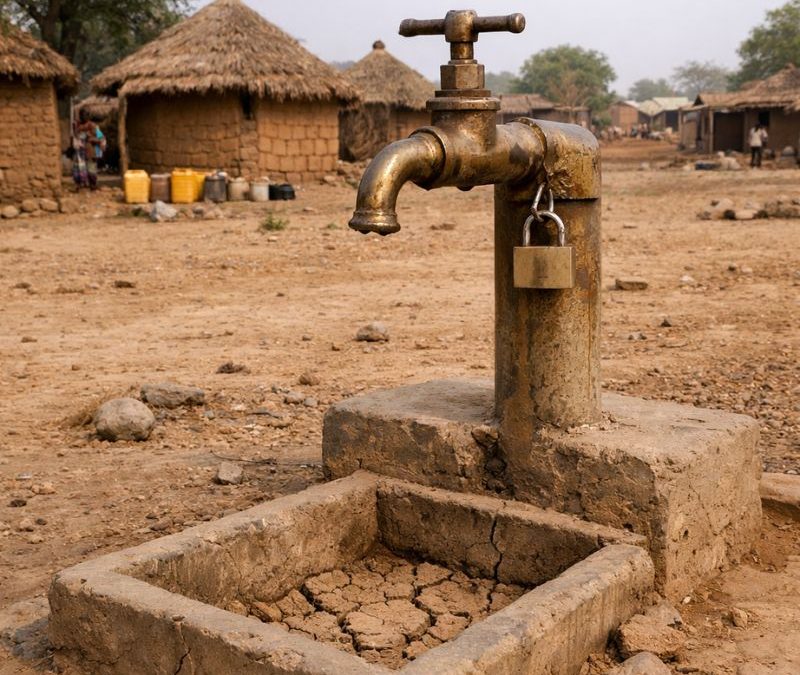
Cry, the Thirsty Country
Johannesburg, South Africa – The ANC government’s decision to expel Israel’s Chargé d’Affaires, Ariel Seidman, is an act of staggering moral bankruptcy – a choice that exposes a ruling party more committed to ideological hostility than to the welfare of the people it has so profoundly failed.
Let us strip away the euphemisms and the lies.
A diplomat was declared persona non grata not for espionage, not for misconduct, not for breaching protocol – but for the unforgivable crime of helping South Africans get water. Clean water.
In a country where taps run dry, where children walk kilometres with buckets, where elderly women queue for hours at communal pumps, and where the state has normalised collapse, neglect, and decay, the ANC chose to punish the one party actually delivering solutions.
The Israeli Embassy partnered openly and transparently with recognised traditional leadership in the Eastern Cape – a region long abandoned by the state, stripped of dignity by years of corruption, incompetence, and indifference. They worked with communities and civil society to do what the government has spectacularly failed to do: provide basic human necessities.
And when those solutions began to materialise, when water flowed where excuses had ruled, the ANC did not respond with humility or gratitude. It responded with expulsion.
Let us also be honest about the real reason this government reacted with such fury. This was never truly about process, protocol, or sovereignty. It was about Israel. About the world’s only Jewish state daring to help South Africans where the ANC has failed for decades. That is the offence that could not be forgiven.
While Israel helps rural communities access water, the ANC government conducts naval war games with its Iranian allies – a regime that openly calls for the destruction of Israel, arms terrorist proxies across the Middle East, jails journalists, executes dissidents, and brutalises women for demanding basic freedom.
This government finds no moral conflict aligning itself with theocratic authoritarianism, yet erupts in outrage when a Jewish state delivers clean water to abandoned South African communities.
This is not principled foreign policy. It is ideological hostility masquerading as virtue.
Humanitarian engagement with civil society and traditional leadership is standard diplomatic practice worldwide. What the ANC cannot tolerate is uncontrolled competence. Aid that bypasses the patronage machine. Help that cannot be claimed, captured, or corrupted. Solutions that empower people rather than entrench dependency.
The contrast is what terrifies them: delivery versus decay, competence versus collapse, action versus slogans.
Aid from authoritarian allies is welcomed when it flatters the ANC’s geopolitical theatre. Aid from Israel is punished precisely because it exposes the emptiness of the state’s own performance. When help arrives without cadres, kickbacks, or press conferences, the mask slips.
The message sent by this government is as obscene as it is clear: if assistance cannot be politically owned, it must be destroyed, even if people suffer.
This is not foreign policy. It is cruelty disguised as sovereignty. It is failure weaponised as ideology.
By blocking humanitarian assistance that exposed state collapse, the ANC has announced to the world that South Africa is hostile to solutions, allergic to accountability, and prepared to let its own people go thirsty to preserve an ideological posture.
The cost of this decision will not be paid in diplomatic communiqués or international applause. It will be paid by communities who remain without water, by children who will continue to drink from unsafe sources, and by villages left stranded because ideology mattered more than survival.
Other nations are watching. And they will remember this – that humanitarian aid in South Africa is welcome only if it props up the ruling party’s illusion of control, and criminalised the moment it reveals the truth.
Water is not a bargaining chip. It is not an ideological talking point. It is not collateral damage in a foreign policy performance.
Children do not care about geopolitics when they are thirsty. Grandmothers carrying buckets do not benefit from slogans about sovereignty. Human dignity does not survive on press statements and ideological alignment.
The ANC has once again demonstrated that it will sacrifice the lived needs of South Africans on the altar of factional obsession and imported political hatred. It has chosen performative rage over practical relief, dogma over dignity, optics over lives.
When a government blocks water to make a political point, it forfeits any claim to moral authority. When humanitarian assistance is rejected because it exposes failure, the rot is complete.
South Africans deserve water.
They deserve dignity.
They deserve solutions.
They do not deserve a government so brittle, so cynical, and so morally bankrupt that compassion itself becomes a political threat.
Our beautiful South Africa deserves better than this.
Cry, the Thirsty Country.