
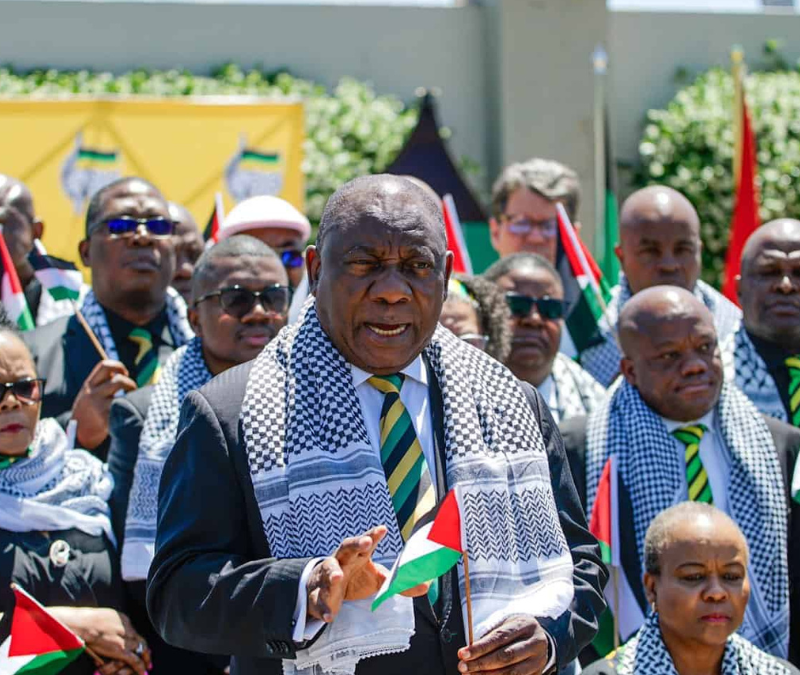
Johannesburg, South Africa – The South African Zionist Federation notes the Presidency’s statement on Israel’s ICJ response filing, and notes, above all, what it conspicuously omits.
In nearly 500 words, President Ramaphosa does not mention Hamas once. That is not an oversight. It is a policy.
A government genuinely committed to civilian protection would acknowledge that Hamas initiated this war on 7 October 2023 with the largest massacre of Jews since the Holocaust. It would acknowledge that Israel’s military campaign was directed at Hamas, a terrorist organisation that deliberately embeds itself within civilian infrastructure, using hospitals, schools and residential areas as operational cover precisely to maximise the appearance of civilian harm. It would acknowledge that Hamas diverted humanitarian aid, and held hostages, including individuals with South African ties, in conditions amounting to torture for over two years. South Africa’s government has said almost nothing about any of this, then or now.
On the ICJ, the Presidency’s statement is no more honest. The Court has not found that Israel is committing genocide. Any official who implies otherwise is either ignorant of the ruling or wilfully misrepresenting it. The Court recognised a plausible claim under the Genocide Convention, a procedural threshold, not a finding on the merits. South Africa has spent two years exploiting that distinction in its public communications, and this statement continues the pattern.
President Ramaphosa calls this moment “an opportunity to unite humanity.” One must ask: which humanity? Not the families of the hostages who spent over a year in Gaza tunnels before the ceasefire secured their return. Not the Israelis still living under the threat of attack. In Pretoria’s telling, Jewish victims simply do not appear.
South Africa’s conduct in this case is not the application of international law. It is its instrumentalisation, using the ICJ as a political platform while lecturing the world about the UN Charter and deepening ties with governments that routinely violate it. A foreign policy that cannot bring itself to acknowledge a ceasefire it had no hand in securing, or welcome the return of hostages it never advocated for, is not principled diplomacy. It is performance.
Selective outrage is not principle. A foreign policy built on the erasure of Israeli victims is not human rights advocacy.
It is something else entirely.